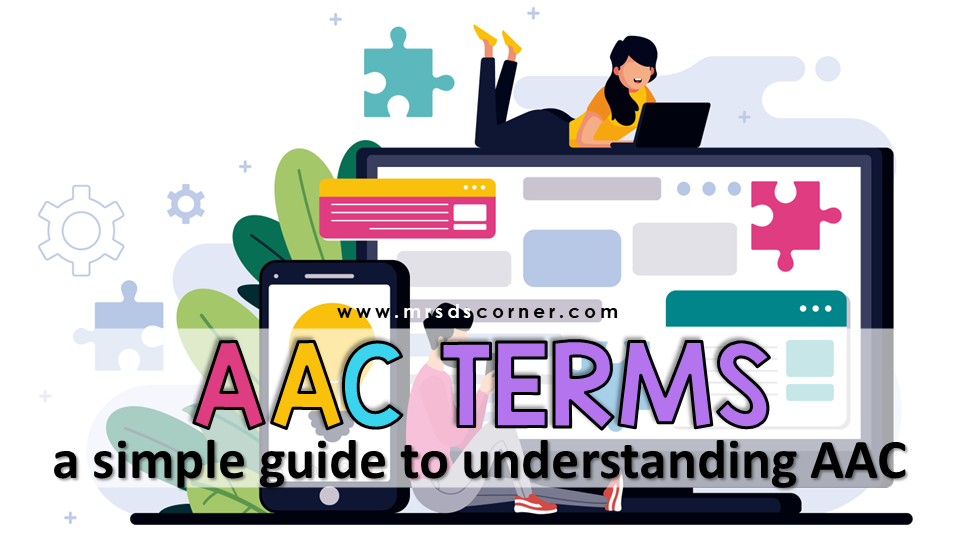
In the event you’ve ever sat in an IEP assembly and heard one thing like, “Let’s trial a dynamic show VOCA with message prediction and scanning entry…”, and also you nodded whereas secretly considering, I hope nobody asks me to outline that… you aren’t alone.
AAC terminology can really feel intimidating. However when you perceive the vocabulary, all the things begins to make sense.
Let’s break it down in plain trainer language.
Understanding AAC terminology helps particular training academics confidently implement Augmentative and Different Communication helps within the classroom.
What Is AAC? Augmentative and Different Communication Defined
Augmentative and Different Communication (AAC) refers to instruments and methods used to assist people with important expressive communication difficulties.
AAC can:
- Increase speech (assist speech that’s obscure)
- Present another when a pupil doesn’t use verbal speech functionally
AAC within the classroom offers college students entry to:
- Tutorial participation
- Social interplay
- Conduct regulation
- Self-advocacy
AAC isn’t “additional assist.” It’s communication entry.
AAC System vs. AAC Technique: What’s the Distinction?
This is among the commonest factors of confusion in particular training.
What Is an AAC System?
An AAC system consists of:
- Symbols (footage, phrases, indicators)
- Aids (gadgets or communication books)
- Methods
- Strategies
Examples of AAC methods:
- A printed communication board
- A PECS binder
- A speech-generating machine (SGD)
- A high-tech dynamic show machine
When groups talk about choosing an AAC system, they’re referring to the total communication setup.
What Is an AAC Technique?
An AAC technique is how the system is used.
Examples embody:
- Aided language stimulation (modeling)
- Prompting hierarchies
- Instructing scanning
- Increasing utterances
Similar machine.
Completely different technique.
Very completely different outcomes.
Symbols and Icons in AAC: Why Vocabulary Group Issues
In AAC:
- Symbols symbolize one thing else (footage, gestures, indicators, phrases, objects, spoken phrases, Braille).
- Icons usually seek advice from the photographs on communication gadgets.
Vocabulary group is intentional.
For instance:
- Choosing “Meals” opens breakfast, lunch, dinner.
- Choosing “Lunch” opens particular objects.
This characteristic known as message prediction, and it helps language improvement by means of organized navigation.
That is how college students transfer from requesting to constructing significant language.
Static vs. Dynamic Show AAC Gadgets
Understanding the distinction between static and dynamic show methods is essential for academics implementing AAC.
What Is a VOCA? (Static Show)
A Voice Output Communication Help (VOCA) is often a static show machine.
Static means:
- The photographs don’t change routinely.
- An grownup data the voice output.
- Pages should be manually up to date.
Static methods are sometimes used for early communicators and will be very efficient when used deliberately.
What Is a Dynamic Show System?
A dynamic show AAC machine adjustments screens routinely.
Instance:
- Scholar faucets “Meals”
- Display adjustments to meal choices
- Scholar faucets “Lunch”
- Display adjustments to lunch selections
Dynamic show methods:
- Help unbiased navigation
- Permit expanded vocabulary
- Encourage sentence constructing
Most trendy high-tech AAC gadgets function this fashion.
Digitized Speech vs. Artificial Speech (Textual content-to-Speech)
AAC gadgets produce voice output in two most important methods.
Digitized Speech
- Actual human voice recorded and saved
- Performed again when button is pressed
Artificial Speech (Textual content-to-Speech)
- Pc-generated voice
- Phrases typed or chosen are transformed into speech routinely

Artificial speech permits college students to generate novel sentences, not simply pre-recorded phrases.
This helps true language improvement.
What Is Scanning in AAC?
Scanning is an oblique entry methodology utilized by college students with bodily or motor limitations.
As a substitute of touching the display screen:
- The machine highlights choices one by one.
- The scholar prompts a swap to pick.
There may be additionally directed scanning, the place the coed controls the scanning path utilizing a number of switches.
Entry methodology issues simply as a lot as vocabulary choice.
What Is PECS?
PECS (Image Trade Communication System) is a structured picture-based communication method.
Historically:
- The grownup doesn’t converse.
- The scholar exchanges an image to request.
PECS performed an essential historic function in AAC improvement.
At the moment, many groups prioritize speech-generating gadgets as a result of:
- They supply auditory suggestions.
- They assist modeling.
- They promote language growth.
Whole Communication and Aided Language Stimulation
Whole communication means pairing spoken language with indicators or symbols.
Most educators now seek advice from this as Aided Language Stimulation, which is modeling language on the coed’s AAC system whereas talking.
And right here is an important reminder:
AAC isn’t about getting college students to “use the machine.”
It’s about adults modeling use it.
Language is caught earlier than it’s taught. It’s essential to encourage, and never require, in order that we don’t unintentionally develop adverse connotations for our college students with their AAC methods.

Unaided AAC Strategies
Not all AAC requires a tool.
Unaided strategies embody:
- Gestures
- Guide indicators
- Facial expressions
AAC exists on a continuum. It isn’t only a pill, or a board, or a set of playing cards.
When academics perceive AAC terminology:
- IEP conferences really feel much less overwhelming
- Collaboration with SLPs improves
- Implementation turns into extra intentional
- College students obtain extra constant assist
Don’t fear, you don’t have to be an AAC specialist. You simply want readability. And readability builds confidence, which is what your college students and their crew want from you.
Trending Merchandise