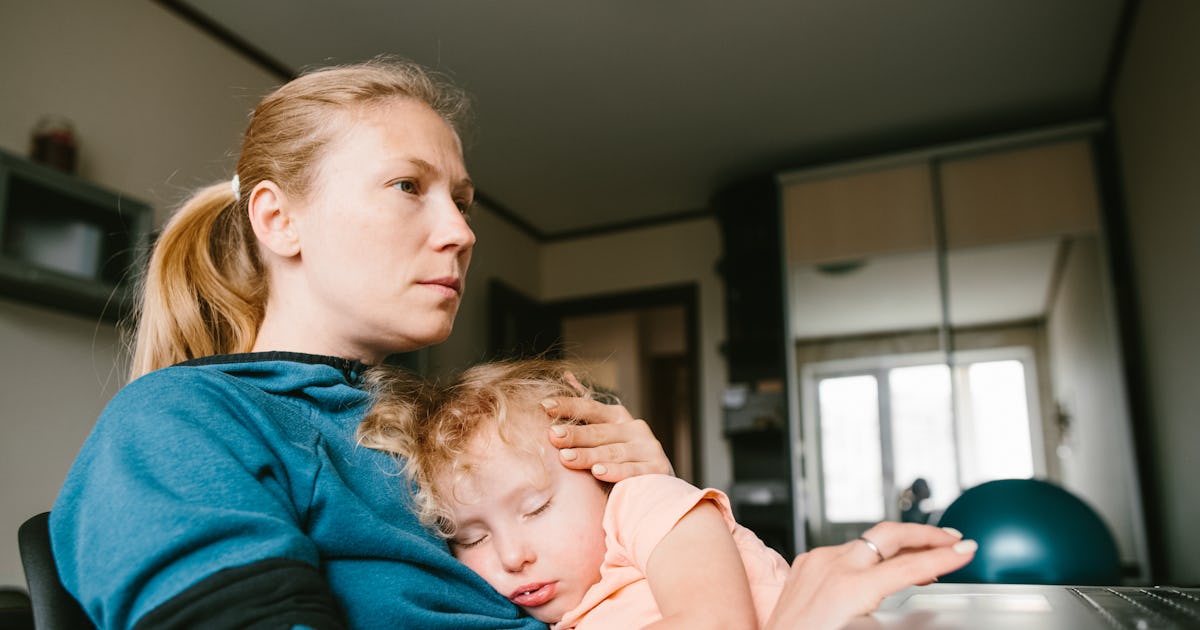
My toddler is stuffy-nosed and feverish, so I cancel the sitter who was supposed to look at him throughout my digital assembly. It might be impolite to show her to a chilly.
Which implies I’ll take the assembly with my toddler within the background. I don’t have a selection — it’s a gathering I can’t miss. Possibly he’ll sleep. Or play quietly by means of it.
Wishful considering.
When 1:00 p.m. rolls in, he’s clingy and conscious, so I take the assembly outdoors, hoping that contemporary air in nature will purchase me an hour. “Hello, I simply wish to flag that my toddler shall be within the background at present,” I start. “He’s sick, and I needed to cancel my sitter.”
I’m assured it’s high-quality. Nonetheless, when the toddler begins fussing at minute 50, I mute my mic, my abdomen winding into a decent knot. I really feel wildly unprofessional.
My husband works at a college and might’t simply get protection, in order a freelancer working from residence, the sick-day math usually lands on me. Even when our roles had been reversed, I’ve a sense I’d nonetheless be making an attempt to rearrange my schedule to make the pediatrician appointment, play the nurse position, and work with the feverish toddler on my lap.
Is it biology? Social conditioning? The way in which my youngsters instinctively seek for me after they don’t really feel effectively? Or is it that I’ve embraced the mother position so onerous that my kids don’t settle for their father’s care in moments like these? Possibly it’s all of it.
I’m not alone.
A Genexa survey of 1,000 U.S. mothers discovered that 70% use their very own sick days to remain residence when their little one is in poor health, and 58% make money working from home whereas caregiving. In different phrases, many people are doing the identical unattainable math: caring for sick youngsters whereas making an attempt to maintain our work lives transferring.
As moms, we are inclined to blame ourselves for his or her infinite sicknesses — for not giving them sufficient Vitamin D, or forgetting to make them wash their palms earlier than consuming, or letting them play at that dirty playplace.
However the fact is, youngsters simply get sick. So much.
Actually, in response to Mayo Clinic Press, youngsters can have as many as 12 colds per year. And public well being officers say this yr’s chilly and flu season is among the worst in decades, which means longer recoveries and extra cancelled childcare for mothers.
We’re dwelling in a system that requires caretakers, particularly girls, to “soak up unattainable calls for,” Anne Welsh, a scientific psychologist and govt coach, tells me. “Moms are requested to mom like they don’t work and work like they don’t mom … it’s an unattainable bind.”
I needed to know why this retains occurring and why it feels so private, so I turned to the consultants.
Why am I the one rearranging all the pieces?
The customarily unstated cultural perception is that, sure, moms are higher at caregiving, Welsh informs me: “Higher at comforting. Higher at soothing. Higher at realizing what to do.”
With that perception, moms have a tendency to hunt out jobs that supply flexibility. “Over time, that flexibility turns into the rationale for why they need to be the one to step in once more,” she says.
Mother and father additionally cling to the concept their sick little one must be tucked into mattress with do-it-yourself soup and a doting mom close by, provides Dawn Friedman, a scientific counselor and father or mother educator. However all through historical past, dad and mom have needed to work, and it hasn’t doomed kids.
What has suffered, nonetheless, is a mom’s sense of equity.
“Moms are requested to mom like they don’t work and work like they don’t mom.”
Mother and father hardly ever have express conversations about who will deal with sick care, says Olivia Bergeron, a psychotherapist and father or mother coach. She says mothers step up, however this usually comes with resentment in direction of their companions, guilt about being a distracted worker, and disgrace about not with the ability to “do all of it.”
Bergeron shares a well-recognized psychological loop: It is so unfair that my associate did not even provide to remain residence. Then: What sort of mom does not wish to keep residence together with her sick little one? And at last, I am an terrible mom for having these ideas and emotions.
So, what’s a mom to do?
Make a “cope forward” plan — have conversations earlier than sickness hits about who will keep residence, how work shall be dealt with, and what backup choices exist, Bergeron recommends. Fathers are succesful caregivers, she emphasizes, and plans ought to honor each dad and mom’ work and well-being.
For single moms who don’t have entry to backup care, it simply signifies that sick days turn out to be that rather more isolating and exhausting. Bergeron recommends getting inventive by figuring out potential helpers locally, together with household, associates, babysitters, and even nannies on mortgage from different households.
After which there are different realities we have now to seek out workarounds for, too.
Making an attempt to make money working from home with a sick child is a particular type of hell.
It’s hardly ever easy. You get the decision to choose up the child early, whisk them off to the pediatrician, decide up the meds, and nonetheless make it residence in time for the three:00 p.m. Zoom board assembly.
How do you do it with out dropping your thoughts?
Bear in mind what anchors you, says Blanka Molnar, a parenting coach and holistic therapist. That may appear like a playlist of favourite songs, transferring your physique, ingesting a great cup of espresso or tea, journaling, or deep respiratory to calm your nervous system. These small, microdosed moments of pleasure can floor us and assist us to maintain our cool, Molnar says.
It’s additionally acceptable to set boundaries together with your work and allow them to know you’ll have restricted availability on sick-care days. She recommends specializing in one process at a time slightly than working your self right into a frazzled exhaustion.
Maybe, most significantly, decrease your expectations on lately. “Begin with your self. In case you attempt to stick rigidly to excessive requirements, you’ll break,” Molnar cautions.
You employ all of your PTO… and then you definately get sick too.
Right here’s a well-recognized situation: You nurse your little one again to well being, solely to catch the bug your self.
For folks with persistent situations, corresponding to most cancers, diabetes, and coronary heart illness, the stakes are even larger. Three in 4 American adults have a minimum of one persistent situation, and plenty of depend on immunocompromising medicines that may flip a easy chilly into weeks of missed work and even hospitalization.
Hilary Hodge, a mom dwelling with two illnesses, is aware of this actuality firsthand. She now coaches dad and mom on methods to cut back their probabilities of getting sick.
Her recommendation contains:
- Asking kids to scrub their palms as quickly as they get residence
- Carrying a masks throughout shut contact when youngsters are actively in poor health
- Encouraging kisses in your hair or the again of the top as a substitute of your face
- Operating an air air purifier with a HEPA filter, and opening home windows when climate permits
However typically, once you do all the pieces “proper,” you continue to fall in poor health. And simply as you begin to recuperate, one other member of the family comes down with one thing new and nasty.
We are able to’t win, can we?
That’s the purpose.
Chilly and flu season is a “magnified model of working motherhood always: that ambition paradox of eager to excel in each areas whereas working in a system that is not arrange for that…there’s no margin. There’s simply fixed triage,” says Welsh.
Children will preserve getting sick. Conferences will preserve getting scheduled. And someplace, one other mom shall be doing the unattainable math of working motherhood, muting her mic whereas her feverish toddler fusses beside her.
Trending Merchandise